GPT-Live Makes Voice AI Feel More Like a Real Conversation
OpenAI's GPT-Live introduces full-duplex conversation, natural turn-taking, and background delegation for search and reasoning. Here is what it changes for voice AI workflows.
Published by HookForge AI.
A different architecture for voice interaction
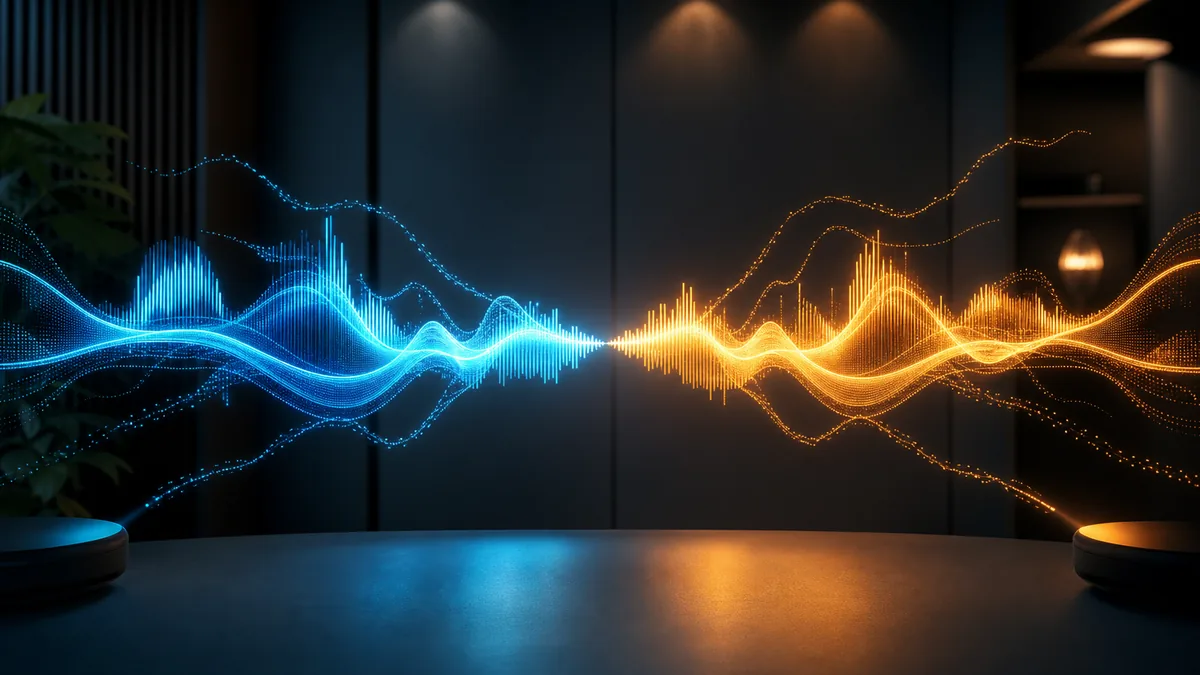
OpenAI introduced GPT-Live on July 8, 2026 as a new generation of voice models powering ChatGPT Voice. Its defining capability is full-duplex interaction: the system can listen and speak at the same time instead of forcing every conversation into a rigid sequence of recording, processing, and playback.
That architecture supports faster back-and-forth, natural interruptions, brief acknowledgements, and pauses that do not immediately end a turn. These details may sound small, but they determine whether a voice system feels like a form or a conversation.
Fast dialogue can delegate difficult work
GPT-Live separates the continuous conversation layer from deeper reasoning. When a request needs web search, analysis, or a longer task, the voice model can delegate work to a frontier model in the background and maintain the interaction while the result is prepared.
This pattern is useful beyond consumer assistants. A support agent can keep gathering context while a separate process checks an account. A field worker can continue describing a problem while an analysis tool reviews documentation. A tutor can keep the learner engaged while preparing a more detailed explanation.
How to design better voice prompts
Voice workflows need explicit conversational policies. Define when the assistant should interrupt, when it should wait, how it confirms important details, and which actions require a clear verbal approval. Responses should be shorter than text answers, with one idea at a time and an option to request detail.
Design for imperfect audio. Names, addresses, prices, medical terms, and account actions should be repeated or confirmed. The system should identify uncertainty rather than silently guessing. A written summary is useful after long or consequential conversations.
Limitations still matter
At launch, OpenAI says GPT-Live does not support voice combined with video or screen sharing in ChatGPT. Language quality and accents can also vary. Teams should test real environments containing background noise, overlapping speech, network delays, and different speaking styles instead of relying only on quiet demonstrations.
The practical takeaway
GPT-Live points toward interfaces where conversation remains responsive while specialized models and tools work behind the scenes. The strongest products will combine natural turn-taking with transparent delegation, confirmation for high-impact actions, and a reliable fallback when speech is unclear.
Official source
Read OpenAI's GPT-Live announcement.